I Am Mother from The Voice Project on Vimeo.
Tuesday, March 27, 2012

Friday, March 16, 2012
Psalm 19

For the director of music. A psalm of David.
The heavens declare the glory of God;
the skies proclaim the work of his hands.
Day after day they pour forth speech;
night after night they reveal knowledge.
They have no speech, they use no words;
no sound is heard from them.
Yet their voice goes out into all the earth,
their words to the ends of the world.
In the heavens God has pitched a tent for the sun.
It is like a bridegroom coming out of his chamber,
like a champion rejoicing to run his course.
It rises at one end of the heavens
and makes its circuit to the other;
nothing is deprived of its warmth.
The law of the LORD is perfect,
refreshing the soul.
The statutes of the LORD are trustworthy,
making wise the simple.
The precepts of the LORD are right,
giving joy to the heart.
The commands of the LORD are radiant,
giving light to the eyes.
The fear of the LORD is pure,
enduring forever.
The decrees of the LORD are firm,
and all of them are righteous.
They are more precious than gold,
than much pure gold;
they are sweeter than honey,
than honey from the honeycomb.
By them your servant is warned;
in keeping them there is great reward.
But who can discern their own errors?
Forgive my hidden faults.
Keep your servant also from willful sins;
may they not rule over me.
Then I will be blameless,
innocent of great transgression.
May these words of my mouth and this meditation of my heart
be pleasing in your sight,
LORD, my Rock and my Redeemer.
Tuesday, March 13, 2012
Eye of the Storm
 The world was falling apart all around me. I was five, huddled into a hotel room in Sumter, South Carolina. We had traveled an hour and half inland to seek refuge from Hurricane Hugo. The bumper-to-bumper traffic on every road headed west was over-flowing with our fellow evacuees. Our home was on the very river forecasters were predicting the hurricane to make landfall over, we had no choice but to leave. Hugo was a strong category four hurricane and we rightfully feared the worst.
Sumter wasn't far enough as tornadoes ripped the town to shreds during the night. I'll never forget the sounds of that night, as if the wind turned to metal and proceeded to clash with the very gods. The carnage that we awoke to the next day proved greater than we could imagine. As we drove home around downed trees and power lines, witnessing others' homes who had been destroyed, we hoped to find our coastal home still standing. Hope may be an overstatement.
Anyone who has lived trough a severe hurricane knows the power that they wield, power to destroy. They deserve their names because unlike any other weather phenomenon, they have a personality, a vengeance and sometimes a grace. We talk about them like we knew them, because we did.
One of the unique characteristic of hurricanes are
 thier eyes. When you look a satellite image of one, it stares at you ominously. It is from this core the whole storm derives its sheer force but phenomenally, the eye is absolutely calm. The eye of Hugo missed our home to the south but I had friends who braved (or fooled) out the storm and found themselves in the eye. They reported that it was like the storm had ended, they would walk out to a light breeze and rays of sun. But swirling all around them were 150 mile per hour winds ravaging everything in its path. But there was safety in the eye.
Jesus tells his followers that in this world we will have trouble and a quick look around affirms this teaching. When we read the headlines and listen to the stories around us, it can seem as if the world is falling apart. It is more scary than gods clashing because it seems as if the gods have left us and hope in safety is hopeless.
But just as Jesus promised us trouble, he promises us joy in its very presence. This is not a disembodied joy where everything is perfect and clean, but joy that finds itself knee-deep in the mud; a joy found in the very eye of the storm.
And what is the source of this joy? Jesus has overcome death.
As the world rages, we know the story does not end there but that even through that rage, joy will come. Because we do not hope in ourselves or the gods, but in the crucified and resurrected Jesus. The one who found himself in the eye of the storm on the cross, as all the pain of the world cam crashing down on him and death itself took him. But the power of love, the power of God gave him the last laugh.
Its a bit like Lieutenant Dan riding out the hurricane from the mast of Gump's shrimp boat, we find our peace with God in the very face of death, in the eye of the storm.
Monday, March 12, 2012
Wednesday, March 7, 2012
He Created the Heavens and the Earth
On a trip through New Mexico about four years ago, Michala and I decided to stop to hike the rim of a dormant volcano in the north-east corner of the state. The hike was not too strenuous due to the paved road that led to the rim, but the vistas we encountered deserved an all-day affair. We were greeted with views of four states: Colorado, Oklahoma, Texas, and New Mexico.
We could see the Sangre de Cristos in the west and the Black Hills in the east. Beneath us were the remains of the lava rivers that had shaped the landscape many years prior. We were stunned. And then, with a hushed voice, Michala whispered in my ear, “He created the heavens and the earth.” Such simple words, words we’d heard countless times, words made tremendously fresh as we realized just how big and magnificent the earth really is.
Psalm 19 rightly states that “the heavens declare the glory of God.” Creation is singing His praise as it shouts to those who will listen, “Look at Him, He is beyond worthy or all our praise. He is Beauty.”
While God’s glory is found in civilization as well, many find the undisturbed wilderness particularly revelatory. This was true of the romantic artists of the 19th century, especially those of the famed Hudson River School in upstate New York. Thomas Cole wrote of nature as giving our soul “a sweet foretaste of heaven.” And his works certainly displayed this conviction. He made detailed, sprawling landscape paintings that sought to display God’s glory by manipulating light to illuminate certain aspects of his work or to paint a cross shining through the leaves. He created a series of allegorical paintings known as the “Voyage of Life” that visually told the story of life from birth to eternity.
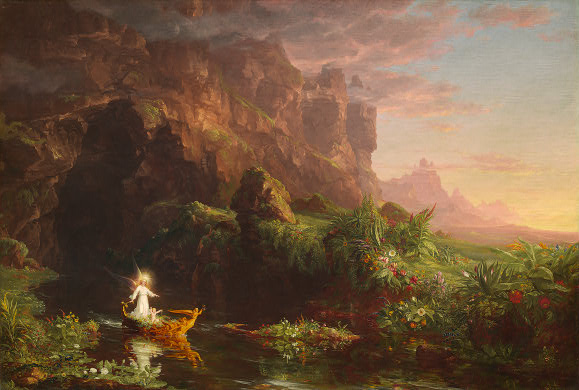
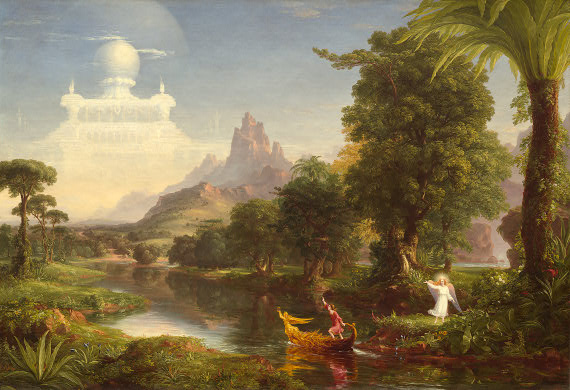
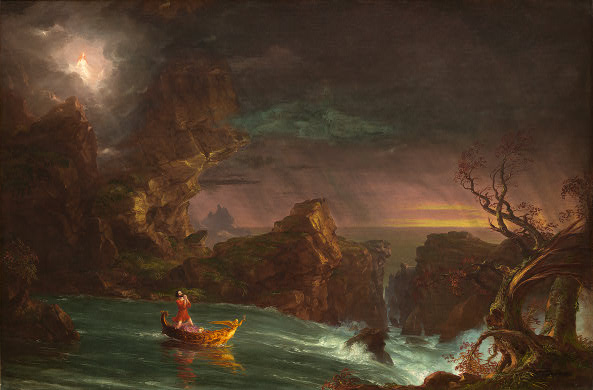
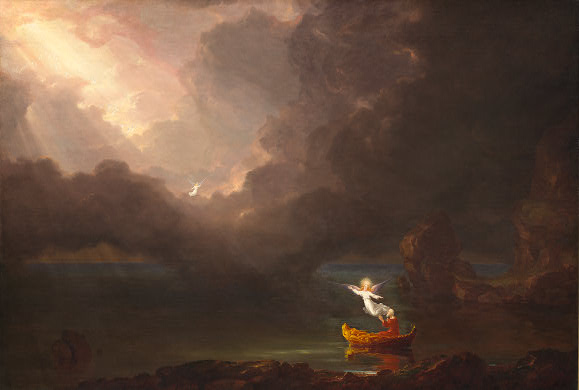
Another famous Hudson River School artist was Fredric Edwin Church, my personal favorite. He painted massive landscapes (his most famous “The Heart of the Andes” was five feet by ten feet). He sought to not only display what was visible in nature but what was not so visible, the great depth of God’s glory just beneath the surface. Here’s a link to his entire collection of works. May you spend a few moments to meditate upon those same words Michala whispered on the volcano top, “God created the heavens and the earth.”
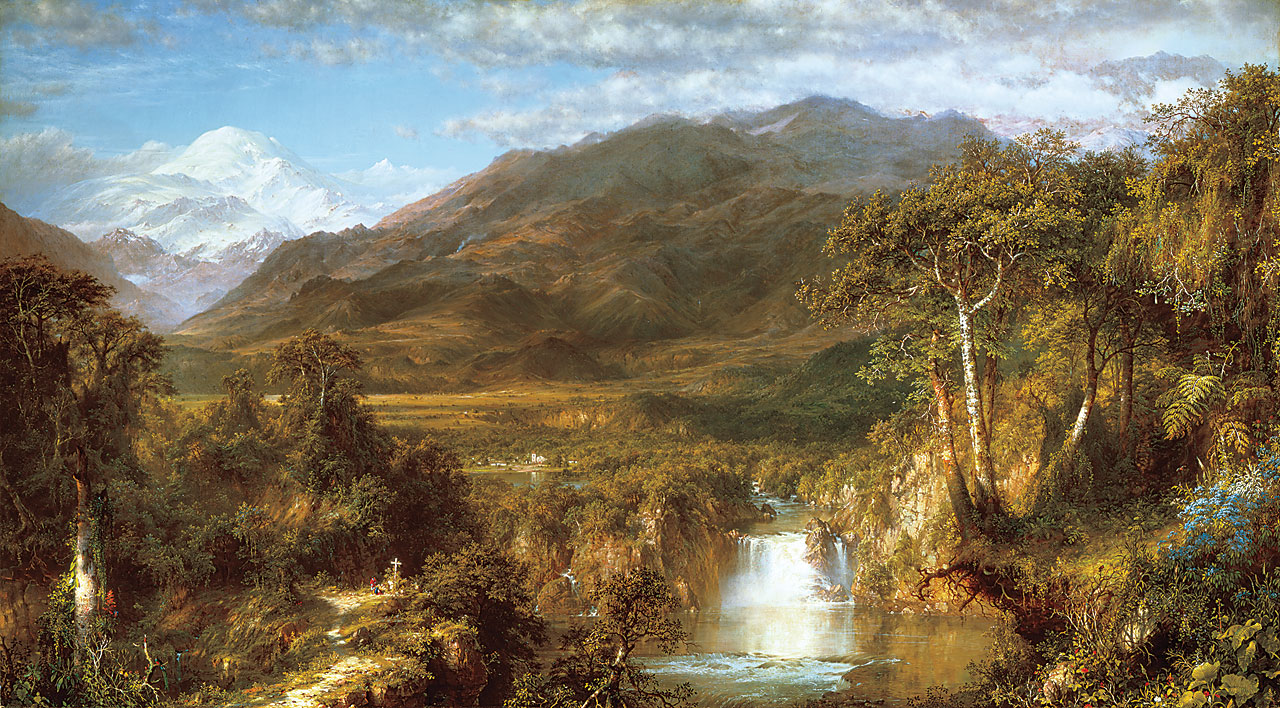
He is glorious!
Tuesday, March 6, 2012
Stop Kony 2012
KONY 2012 is a film and campaign by Invisible Children that aims to make Joseph Kony famous, not to celebrate him, but to raise support for his arrest and set a precedent for international justice.
KONY 2012 from INVISIBLE CHILDREN on Vimeo.
Learn more here: invisiblechildren.com
Monday, March 5, 2012
Giving Up Bad BBQ for Lent

As a little kid, my Dad’s office was a magical place. The walls were decorated with football memorabilia from years ago. He had a model plane of the one my grandfather flew in World War II. But perhaps what enamoured me most of all were his trophies. He had a plaque remembering his hole-in-one and a couple with pigs at the top. He was an award-winning pit-master. My dad had not only practiced the art of smoking meat and making sauce from scratch, he had been rewarded for his prowess. I was especially proud of those trophies because of where we lived: South Carolina.
Read the rest of this post at The Neighborhood Cafe
Saturday, March 3, 2012
Friday, March 2, 2012
The Peace of Wild Things
When despair for the world grows in meand I wake in the night at the least soundin fear of what my life and my children’s lives may be,I go and lie down where the wood drakerests in his beauty on the water, and the great heron feeds.I come into the peace of wild thingswho do not tax their lives with forethoughtof grief. I come into the presence of still water.And I feel above me the day-blind starswaiting with their light. For a timeI rest in the grace of the world, and am free — Wendell Berry
Subscribe to:
Posts (Atom)